

Japanese Exotic Scales
 Hi this time I wish to talk about five scales that have become more or less known among guitarists; the first time I had heard of exotic sounds on electric guitar was when I listen to a record of the scorpions with guitar master Uli John Roth, it was the Tokyo Tapes Live double album. Then a record of UFO with Michael Schenker, then an Accept record called Kaizokuban, And the climax of this came to me with bands such as Cacophony and the records of Marty Friedman and Jason Becker. I’m very interested in exotic scales and exotic sounds so I started to search information about exotic scales in books and videos.
Then David T Chastain came to Mexico and played some Hungarian minor improvisations and he gave me a little booklet with information about a lot of formulas for exotic scales which made me very happy. I still remember that day when I met Michael Harris and David T Chastain. They are super excellent guitarists, heroes of guitarists around the world and the best thing is that they are excellent people too.
OK back to the scales, with David I learnt a Japanese scale called the “Kumoi” scale. It is a five tone scale that has a very brilliant sound and that I practiced a lot until now, when I saw the video of Marty Friedman and he teaches a Japanese scale that is the same as the scale David taught me. Then I got another booklet with 16 exotic scales and there came three scales called Kumoi, Hirajoshi and Iwato among others from China, Hungary, Egypt and Greece etc.
Well I began to practice these scales to learn their positions on the fret board. While I was making diagrams of two and three note per string positions, I discovered something very interesting; the positions of each scale were exactly identical to each other, just with different notes, and then I think “Voila! They are modes of the same scale!”
1. The Hirajoshi Scale
To better understand these scales, we will start with the Hirajoshi scale; it’s a pentatonic scale that has an intervallic structure of W-H-2-H-2. This means that the hirajoshi scale has a whole tone as first intervallic distance, a half tone as second intervallic distance, two whole tones as the third intervallic distance, a half tone as the fourth intervallic distance and our last intervallic distance is of two whole tones. In A tonality we have the following tones: A-B-C-E-F-A. It covers the complete octave with five tones, in the power tab archive you can see various positions of this scale.
The formula for this scale is 1,2,b3,5,b6 which means:
1=root,2=major second,b3=minor second,5=perfect fifth, and b6 is a minor sixth.
Various positions on A tonality

2. The (misnamed) “Kumoi” Scale (Hon Kumoi Shiouzhi Scale)
OK, now we will to look at another Japanese scale commonly known as Kumoi. I know this scale as kumoi, but in my research I’ve found that his real name is Hon Kumoi Shiouzhi. In reality, the name of shiouzhi is referred to one tuning of a Japanese stringed instrument known as Koto, by the way the names Hira, Kumoi, Kokin and Hon Kumoi are tunings with certain intervallic distances from string to string). The Kumoi scale is the first Japanese scale that I learned, it sounds very good and exotic, its intervallic structure is: H-2-W-H-2. This means that our first intervallic distance is of a half tone, our second intervallic distance is of two whole tones, our third distance is of a whole tone, our fourth distance is of a half tone and finally our last distance in this scale is of two whole tones. In the tonality of A, this scale has the following tones: A, Bb, D, E, F A
it has the following formula:1, b2, 4, 5, b6. Which means: 1=root, b2=minor second, 4= perfect fourth, 5= perfect fifth, b6 is a minor sixth.
The hon kumoi shiouzhi in A tonality:
Gtr I (4/4)

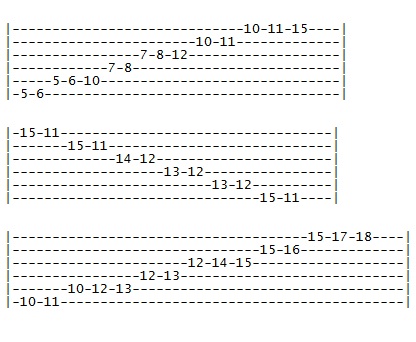
3. The Iwato Scale
This is another Japanese scale, this scale is less known among guitarists, but I think it is very interesting because it sounds real ninja when you play it ha ha. It’s intervallic structure is the following: H-2-H-2-W. This means that in this scale we have an interval of a half tone, then an interval of two whole tones, then another interval of half tone, then two whole tones again and finally we complete our octave with an interval of a whole tone. In the tonality of A, this means:
A-Bb-D-Eb-G-A, and it’s a pentatonic scale too (All the scales in this article are of five tones).
It has a formula of :1 -b2-4-b5-b7.Which means: root, minor second, perfect fourth, diminished fifth ,and minor seventh.
Gtr I (4/4)
4. The (real) Kumoi Scale (The sound of the Samurai)
OK, there exists another two Japanese scales derived from the Hirajoshi Scale, for example, I need to present to you a scale that, with the same set of notes (five notes). The same set of intervals completes an octave, that’s the case of our new friend that comes with intervals arranged in a manner that starts on the interval of 2 whole tones. Well, the scale I’m presenting to you comes with this intervallic structure: 2-H-2-W-H.
This means that our first interval on this scale is of two whole tones, our second interval is of a half tone, our third interval is of two whole tones again, our fourth interval is of a whole tone and our last interval is of half tone. The name of this scale is Kumoi And the scale that we know as Kumoi is in reality named Hon Kumoi Shiouzhi.
If you think a little you will realise that it is a mode of the Hirajoshi scale, I named this scale: Kumoi – The Sound of the Samurai, because it reminds me the noble warriors of Japan, and makes for something a bit different to the Hon Kumoi scale.
The formula for this scale is 1-3-4-6-7, which means root, major third, perfect fourth, major sixth and major seventh.
In the tonality of C it is :C-E-F-A-B-C, In the tonality of A it is : A-C#-D-F#-G#-A.
Positions on A tonality:
Gtr I (4/4)

5. Our Last Japanese Scale
(Chinese scale, Raga Amritavarsini)
This fifth scale is pentatonic Japanese scale that has the same intervals as the ones mentioned before, and is a pentatonic too, just that the intervals are arranged in another order. The intervallic structure is: 2-W-H-2-H .
This means that our first interval is of two whole tones, our second interval is of a whole tone, our third interval is of a half tone, our fourth interval is of two whole tones and our fifth and last interval is of a half tone.
The formula for this scale is: 1-3-#4-5-7, this means: root, major third, augmented fourth, perfect fifth and major seventh.
In the tonality if A it is: A-C#-D#-E-G#. I haven’t found the name of this scale, or at least a Japanese name, in a scale dictionary I got from Toni Lloret, it is named the ‘Chinese scale’ or Hindu scale Raga Amritavarsini.
The Chinese Scale (5th mode of the Hirajoshi scale) or The Raga Amritavarsini on A tonality:
Gtr I (4/4)

6. Kojo No Tsuki
(The light of the Moon over our Japanese scales)
According to a record I have of Japanese folk melodies, “Kojo No Tsuki” means “The light of the Moon over the Ruined Castle.” Now will we see the light of the Moon? First, we need to compare the intervallic structures of every scale we have learned:
Hirajoshi = W-H-2-H-2
Iwato = H-2-H-2-W
Kumoi = 2-H-2-W-H
Hon Kumoi Shiouzhi = H-2-W-H-2
Chinese ,Raga Amritavarsini = 2-W-H-2-H
If you are careful you will notice that every scale begins exactly on the second interval of its precedent and contains the same order of intervals, just that as it begins on the second interval, the first interval passes to be the last interval in our new scale. Well to see it more clearly:
The Hirajoshi scale has W-H-2-H-2 and is the first mode.
The Iwato scale begins on the H interval of the Hirajoshi, and in the same order we have H-2-H-2-W and it is the second mode of our scale.
The Kumoi scale begins on the 2 interval of the Iwato scale, and in the same order now we have 2-H-2-W-H and it is the third mode of our scale.
The Hon Kumoi Shiouzhi scale begins on the H interval of our Kumoi scale and in the same order now we have H-2-W-H-2 and it is the fourth mode of our scale.
Finally, the Chinese scale begins on the 2 interval of our Hon Kumoi Shiouzhi scale, and keeps the same order of intervals, just the first interval now is the last and now we have 2-W-H-2-H. It is our fifth and last mode of the Hirajoshi scale.
Just in case of any doubt:
W-H-2-H-2 ———————————Hirajoshi
H-2-H-2-W———————————-Iwato
2-H-2-W-H———————————-Kumoi
H-2-W-H-2———————————–Hon Kumoi Shiouzhi
2-W-H-2-H———————————-Chinese ,Raga Amritavarsini
OK. Now you have the formulas and maybe some positions of these Japanese scales, but you need to take this information and develop it to it’s maximum potential. You can derive chords from all the five scales and compare them, you can mix these scales with another scales as major or minor scales, for example now you can study these scales to incorporate to your arsenal of tools for composition. They provide innumerable elements and options.
Thanks to Shredaholic, I hope these types of lessons help you as an aspiring musician, I recommend you to view all the lessons on this site because they are excellent lessons. If you like this lesson I wish to make the second part, with topics using these scales in combination with our “Well tempered clavier scales”
Thanks and please don’t hesistate to write to me if you wish to comment something












Dude, I just wanted to say how awesome this page is. You’re one hell of a teacher!
Rock on!
Thanks
MArk
hirajoshi not quite the same here…
http://en.wikipedia.org/wiki/Hirajoshi_scale
yo, the Hirajoshi shown in your link is exactly the same: WH2H2
Hello! Thank you very much for this material, I really need more of this stuff.
If you have more info about japanese scales, harmony etc. please contact me!
Keep on working! You are doing a great job!
pretty good post here but i thought you would have mentioned the InSen scale which is 1,b2,4,5,b7 or h,2,w,1.5,h in your notation. i always considered Japanese music to be constructed of just these two scales and the major pentatonic which in this case is normally spelled 1,2,4,5,b7 (2nd mode of major pentatonic) and all their respective modes. also im not sure either of the scales you call kumoi are actually kumoi, i believe it comes from the InSen scale and is spelled 1,2,b3,5,6 (5th mode of InSen). i dont think this is your fault however, because every bloody book i look in tells me a different mode of hirajoshi is the true hirajoshi.
having said this you know that in japan the consider the root of the scale to be the 3rd note, not the 1st? meaning our concept of giving modes different names goes right out the window.
i dont really know what my point is anymore so…
Hey, thanks for these. really wanted a ninja type scale to play. Another awesome lick to add to my shredding arsenal 😀
I was trying to relate these scales some way, but man u nailed it. i mixed up the In scale(i dont kno Sen or something like that, every book speaks for itself) i couldnt get the right thing.
Thank you sir!
nice post, thank you!
Thanks for tabin these scales out i only know of 2 japanese scales now with this i have a lil more to work with.
What is the name of the booklet that you bought that contained all these scales?
Thank you!! You, beautiful musician! These are absolutely gorgeous and I can’t wait to practice them. Thank you for your beautiful generosity in sharing your hard-earned experiences with the world. Much love and gratitude!